
Someone downloads a white paper from your website. Someone else attends three webinars, explores your product pages and then requests a demo. Both have engaged with your business, but the level of interest they have shown is quite different. Then there’s the question of who those people are. The person downloading the white paper might be an ideal potential customer, while the person attending every webinar could be researching something you don’t actually offer.
Lead scoring helps bring those two things together. By allocating points for engagement and fit, you can build a more useful picture of which leads deserve attention and why. The important part is deciding what deserves points, how many to award and what should happen when someone reaches a particular score. Those decisions should come before setting up the rules in whichever platform you use.
Start With a 200-Point Lead Scoring Model
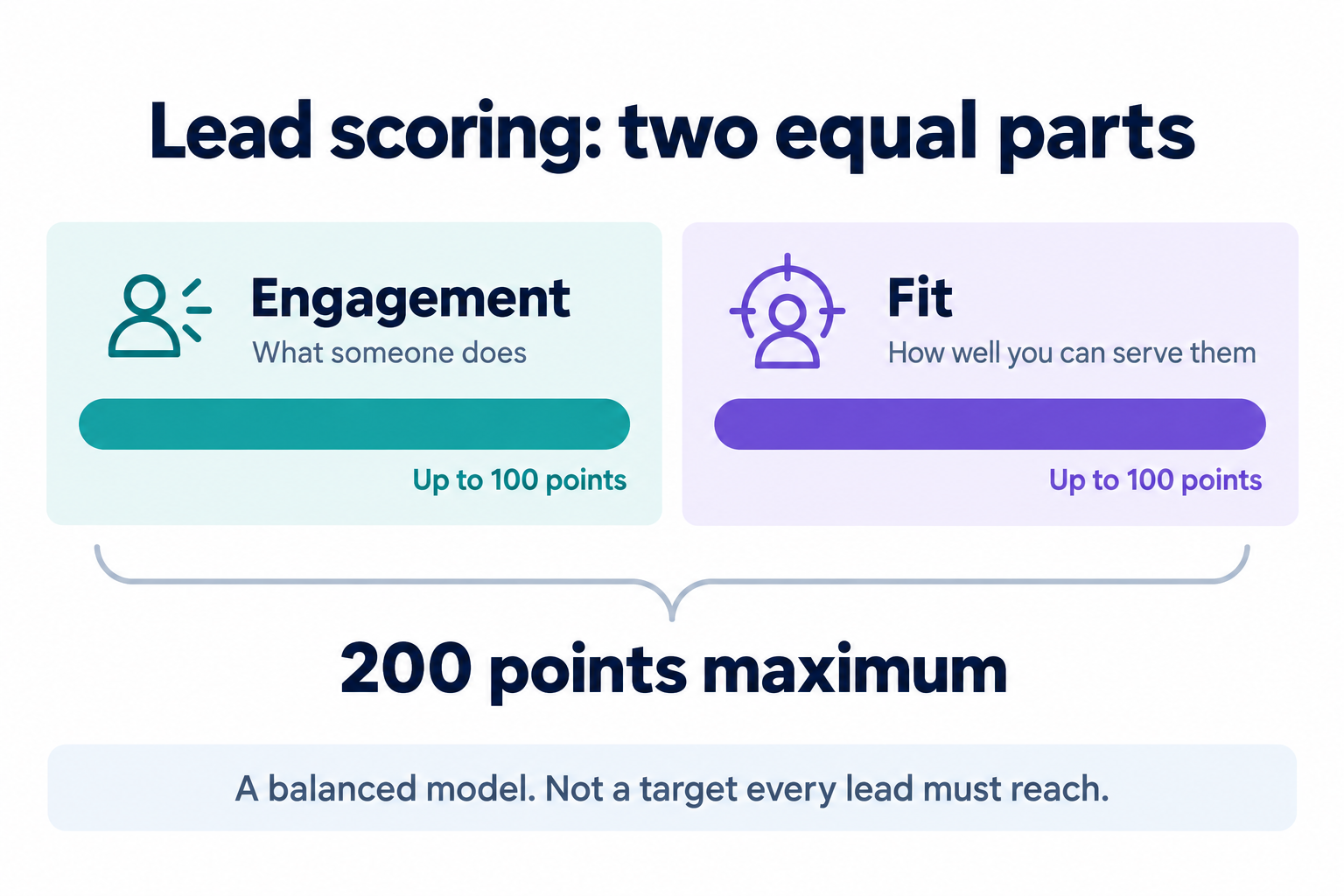
For this example, we’ll use a maximum lead score of 200 points, split equally between two areas:
- Engagement: up to 100 points for what someone does.
- Fit: up to 100 points for how closely the person, their organisation and their requirements match what your business can serve.
Giving both sides the same potential weighting keeps activity in perspective. Someone can be highly engaged without being a suitable potential customer, and someone can look like an excellent fit without showing much interest yet. Each category also has its own maximum. This allows points to build through multiple interactions while preventing someone from reaching the full engagement score simply by clicking enough emails.
The allocations below are a starting point for a business selling to other businesses and just examples to get you started. They should be adjusted based on your offering, your sales cycle and what you learn from the leads that become qualified opportunities. Obviously whatever tool you are using for your marketing efforts comes in to play in terms of what is or isn’t possible, so keep that in mind when building your own lead scoring requirements.
Engagement Scoring Criteria: What Should Earn Points?
Email Engagement
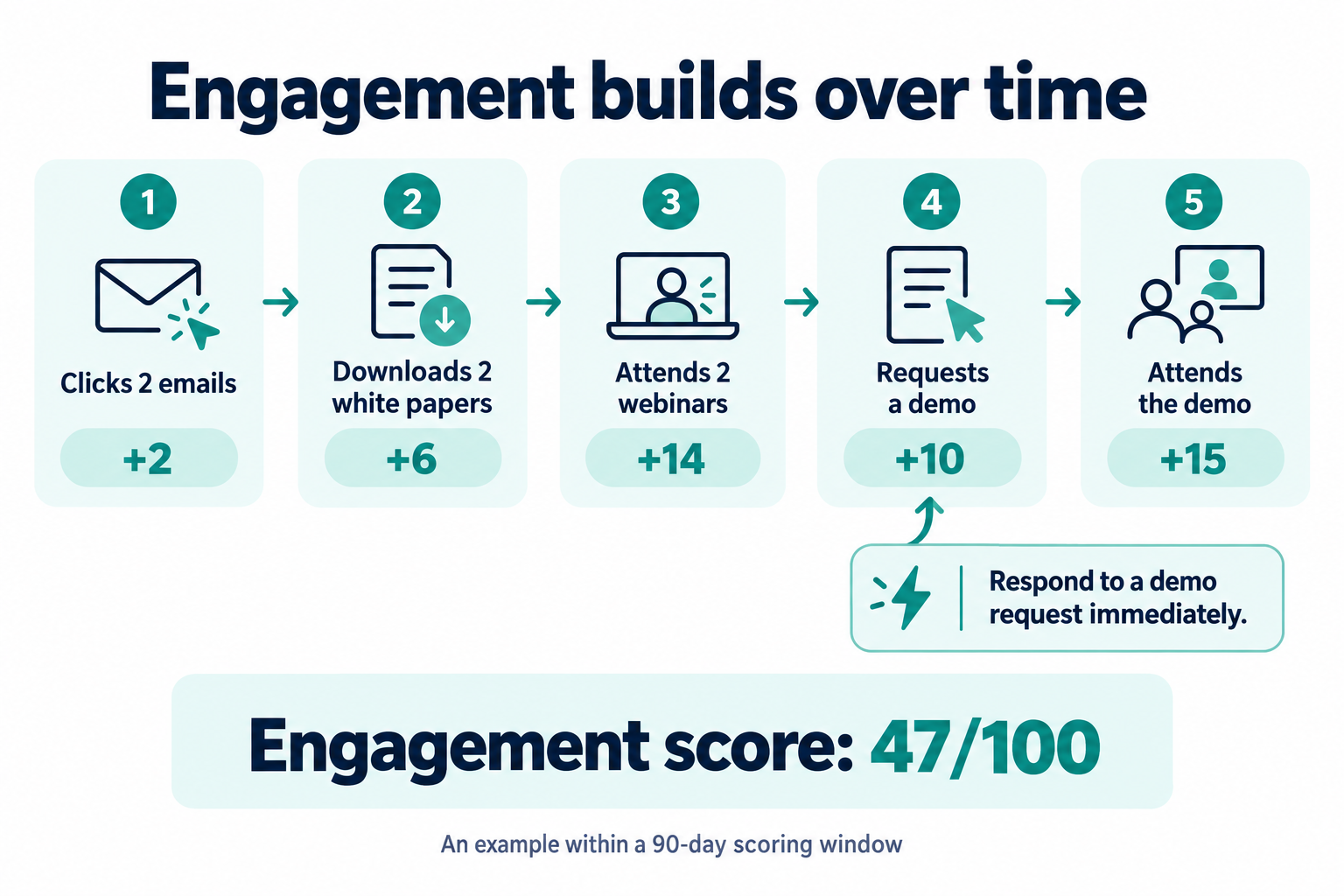
Points: 1 per qualifying email clicked, up to 10
Importance: Low — useful for identifying ongoing interest.
Clicking a relevant email link shows that someone has chosen to explore the content further. A pattern of clicks across several emails can help you understand which topics consistently attract their attention. However, a click doesn’t necessarily mean someone has a business requirement or is considering a purchase. Keeping the individual points low lets email contribute without giving it too much influence over the overall score.
Suggested allocation:
- 1 point for clicking a relevant content link in a marketing email.
- Cap the category at 10 points.
I would give email opens zero points in this model. Privacy features can affect open tracking, making opens a less dependable indication that someone has actually read the message. With some tools, clicks can also be questionable, another reason for keeping the points low.
Website Visits
Points: 1–3 per qualifying page, up to 20
Importance: Medium — the pages visited help explain what someone is exploring.
A single website visit provides limited context. Someone exploring several product pages and then returning to read about pricing or implementation gives you more information about what they might be considering. Smaller allocations allow the score to build as that exploration develops. The points should reflect the purpose of the page, with more weight given to content that helps someone evaluate your offering.
Suggested allocation:
- 1 point for a relevant educational or blog page.
- 2 points for a product, service or solution page.
- 3 points for a pricing, integration or implementation page.
- Cap the category at 20 points.
Careers pages, support pages and unrelated content should be excluded. Those visits may be useful for other purposes, but they don’t necessarily indicate interest in becoming a customer.
Content Downloads
Points: 3–5 per distinct resource, up to 20
Importance: Medium — multiple relevant downloads can indicate sustained research.
Downloading a resource shows that someone is prepared to take an extra step to access information. Downloading several different resources can suggest they are exploring a subject in more detail, particularly when the content relates to the same business challenge. The purpose of the resource matters more than its format. A white paper explaining a topic serves a different purpose from a comparison checklist that helps someone evaluate potential suppliers.
Suggested allocation:
- 3 points for an educational guide or white paper.
- 5 points for a buyer’s guide, comparison checklist or business case resource.
- Cap the category at 20 points.
Someone downloading four evaluation resources could reach the maximum. A mixture of educational and evaluation content would build towards it more gradually, giving you a useful picture of their interests along the way.
Webinars and Events
Points: 2–10 per event, up to 25
Importance: Medium to high — attendance and participation show a commitment of time.
Registering for a webinar tells you that the topic caught someone’s attention. Attending provides a stronger signal because they have committed time to learning more, while repeated attendance can indicate sustained interest. Participation can add further context. A relevant question about a product, use case or implementation requirement may help connect that interest to something the person is actively considering.
Suggested allocation:
- 2 points for registering for a relevant webinar or event.
- 5 points for attendance, increasing the registration points.
- Cap the category at 25 points.
Someone attending three webinars would earn 21 points, with relevant participation helping them reach the maximum. Someone who registers but doesn’t attend would retain only the registration points. Count attendance at a live session and viewing its recording as the same event, so watching both doesn’t generate two sets of points.
Direct Enquiries and Sales Conversations
Points: 5–15 per qualifying action, up to 25
Importance: Very high — the person is actively asking your business to respond.
A direct enquiry is a strong signal because someone has moved beyond consuming information. They are asking a question, requesting time with your team or describing a requirement they want help with. These actions should receive more points individually than general content engagement. There should also be room to recognise progression, such as an initial demo request followed by an attended conversation.
Suggested allocation:
- 5 points for a relevant enquiry describing a business need.
- 10 points for requesting a demo or sales conversation.
- 5 points for attending that conversation or requesting a quote.
- Cap the category at 25 points.
Check the enquiry type before awarding points. Support requests, job applications and supplier approaches shouldn’t be treated as sales enquiries simply because they arrived through a contact form. These requests should also trigger appropriate follow-up immediately. Someone asking to speak to your team shouldn’t have to collect more marketing engagement points before receiving a response.
Fit Scoring Criteria: How Suitable Is the Lead?
Job Role and Buying Involvement
Points: Up to 20
Importance: High — helps establish the person’s involvement in a potential purchase.
Job titles can provide useful context, but they don’t always explain someone’s role in a decision. A senior title doesn’t necessarily mean the person owns the relevant budget, and someone without a management title might be responsible for evaluating the solution. Useful properties include job function, department, job title and buying role. Together, these can help distinguish someone working in a relevant area from someone actively involved in selecting or approving a purchase.
Suggested allocation:
- 5 points for working in a relevant department or function.
- 15 points for being a confirmed user, evaluator or influencer.
- 20 points for being the confirmed decision-maker or budget owner.
- Award the highest matching level, up to 20 points.
These levels shouldn’t be added together. A confirmed decision-maker receives 20 points in this category, rather than receiving additional points for also belonging to the relevant department. Unknown buying involvement should receive zero points until you learn more. Missing information gives you something to qualify, rather than proving that the person is unsuitable.
Industry
Points: Up to 20
Importance: High when your offering serves particular sectors.
Industry can be a useful indicator of fit when your offering addresses sector-specific needs or processes. An organisation operating in a market you understand and actively serve may have requirements that align closely with your experience. Use an industry or sub-industry property with consistent values. This makes the scoring easier to apply and avoids similar organisations receiving different scores because their industries were entered differently.
Suggested allocation:
- 20 points for a priority industry you actively serve.
- 10 points for a related industry with a credible use case.
- 0 points where industry fit is unknown or unproven.
- Award the highest matching level, up to 20 points.
The weighting should reflect your actual offering and customer experience. If industry makes little difference to suitability, move some of these points to a fit category that tells you more, while keeping the total fit maximum at 100.
Company Size
Points: Up to 20
Importance: Medium to high — organisational scale can affect suitability.
Company size can help indicate whether your offering matches an organisation’s needs and complexity. A service designed for a large organisation may be difficult to justify for a small business, while something built for smaller teams may not meet enterprise requirements. Useful properties include employee count, annual revenue or number of locations. Choose the measure that best reflects suitability for your business, rather than awarding points for several measures that tell you broadly the same thing.
Suggested allocation:
- 20 points for falling within your ideal company size range.
- 10 points for an adjacent range you can still serve effectively.
- 0 points where size is unknown or outside your target range.
- Award the highest matching level, up to 20 points.
Bigger shouldn’t automatically mean a higher score. The purpose is to identify organisations whose scale matches what you provide and how you deliver it.
Location and Service Coverage
Points: Up to 10
Importance: Medium — reflects your ability to deliver and support the offering.
Location matters when service delivery depends on territory, language, time zone or local availability. An otherwise relevant organisation may be harder to support if its requirements sit outside the regions you normally cover. Useful properties include country, operating region and required service location. For an organisation with multiple offices, the location of the project may be more relevant than the headquarters address.
Suggested allocation:
- 10 points for a core service region.
- 5 points for a supported region with additional delivery considerations.
- 0 points where service coverage is unknown.
- Award the highest matching level, up to 10 points.
If you know that you cannot serve the required location, consider setting up logic to subtract points where it makes sense. Points earned elsewhere shouldn’t hide a practical reason why you cannot take on the work.
Stated Need and Solution Suitability
Points: Up to 30
Importance: High — provides direct evidence that your offering could meet the requirement.
An organisation might match your target industry and company size without having a requirement you can address. Understanding the problem they want to solve gives you a stronger basis for deciding whether there is a potential opportunity. Useful properties include primary business challenge, required capabilities, existing systems and delivery requirements. The specific properties will depend on what you sell, but they should help establish whether your offering can do what the organisation needs.
Suggested allocation:
- 15 points for a confirmed business need that your offering addresses.
- 15 additional points when the essential requirements have been checked and are compatible with your offering.
- Cap the category at 30 points.
For example, someone might describe a reporting problem your service can solve, earning the first 15 points. If you then establish that you support the systems and delivery requirements involved, they could receive the remaining 15 points. Unknown requirements should receive zero points until confirmed. A known requirement you cannot meet should trigger a qualification review, because a high score in other categories doesn’t resolve a fundamental mismatch.
How the 200 Points Add Up
The category limits give repeated engagement room to contribute while keeping both sides balanced. They also make the score easier to explain, because you can see which activities and attributes are contributing to the total.
| Category | Maximum points |
|---|---|
| Email engagement | 10 |
| Website visits | 20 |
| Content downloads | 20 |
| Webinars and events | 25 |
| Direct enquiries and sales conversations | 25 |
| Engagement subtotal | 100 |
| Job role and buying involvement | 20 |
| Industry | 20 |
| Company size | 20 |
| Location and service coverage | 10 |
| Stated need and solution suitability | 30 |
| Fit subtotal | 100 |
| Combined maximum | 200 |
Reaching a category maximum doesn’t mean the activity stops being useful. Continue recording the engagement so that your team can see the full history, even when further activity doesn’t increase the score. Fit properties should reflect the current information rather than accumulate points every time a value changes. If someone moves from evaluator to decision-maker, their role score changes from 15 to 20; it doesn’t become 35.
Keep Engagement Scores Current
A lead score should reflect recent interest rather than everything someone has ever done. A person who attended several webinars last year may no longer be exploring the topic, even if their organisation remains a good fit. A straightforward starting point is to count engagement from the last 90 days. When activity falls outside that window, its points stop contributing, and the category totals are recalculated from the activity that remains.
That window should reflect your sales cycle. If buying decisions typically take much longer, a longer window may give you a more useful picture of sustained interest. Fit points can remain while the underlying information is accurate. Review them when someone changes role, an organisation changes size or new information alters your understanding of the requirement.
When Should a Lead Score Trigger Sales Follow-Up?
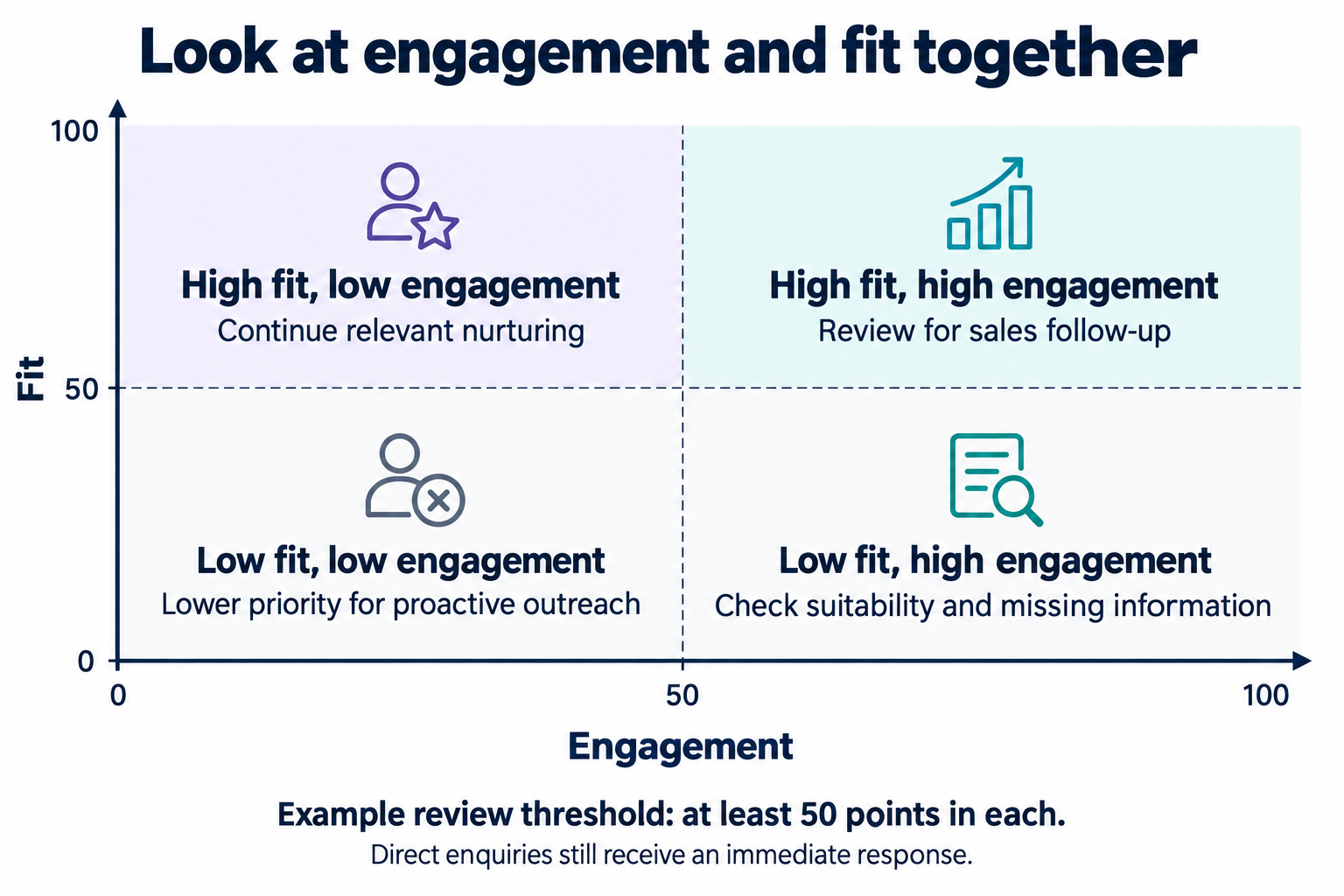
Reaching 200 points shouldn’t be the objective. The purpose is to help your team identify leads worth reviewing and understand what makes them relevant. As a starting rule, you could flag a lead for sales review when it has at least 50 engagement points and 50 fit points. That requires evidence on both sides, rather than allowing a very high score in one area to compensate for a low score in the other.
For example, a lead with 80 engagement points and 20 fit points would have a combined score of 100 but wouldn’t meet that rule. A lead with 55 engagement points and 55 fit points would qualify for review because it has reached the minimum in both areas. Direct sales requests remain an exception and should receive appropriate follow-up regardless of score. Likewise, a confirmed reason you cannot serve the lead should be visible separately, rather than buried beneath a positive total.
Review and Refine Your Lead Scoring Criteria
The first version of a scoring model is a set of assumptions. You are deciding which behaviours and characteristics you expect to be useful, and then checking whether those expectations hold up. Review the results with the people handling the leads. If high-scoring leads rarely become qualified opportunities, look at which categories are contributing most and whether those signals deserve their current weighting.
If good opportunities consistently score too low, investigate what the model is missing. You may need to change the allocations, capture better information or recognise an interaction that currently earns no points.
Putting the Model Into Practice
Agreeing on the logic gives you a clearer starting point for implementation. You’ll know which activities to track, which properties to maintain, how repeat interactions should count and what should happen when a lead reaches the review threshold.
Check out posts for setting up Lead Scores in HubSpot and Customer Insights – Journeys if you are using either of those two platforms. Whichever tool you use, the score should help your team understand both the interest someone has shown and how well your business can meet their needs.




Leave a Reply